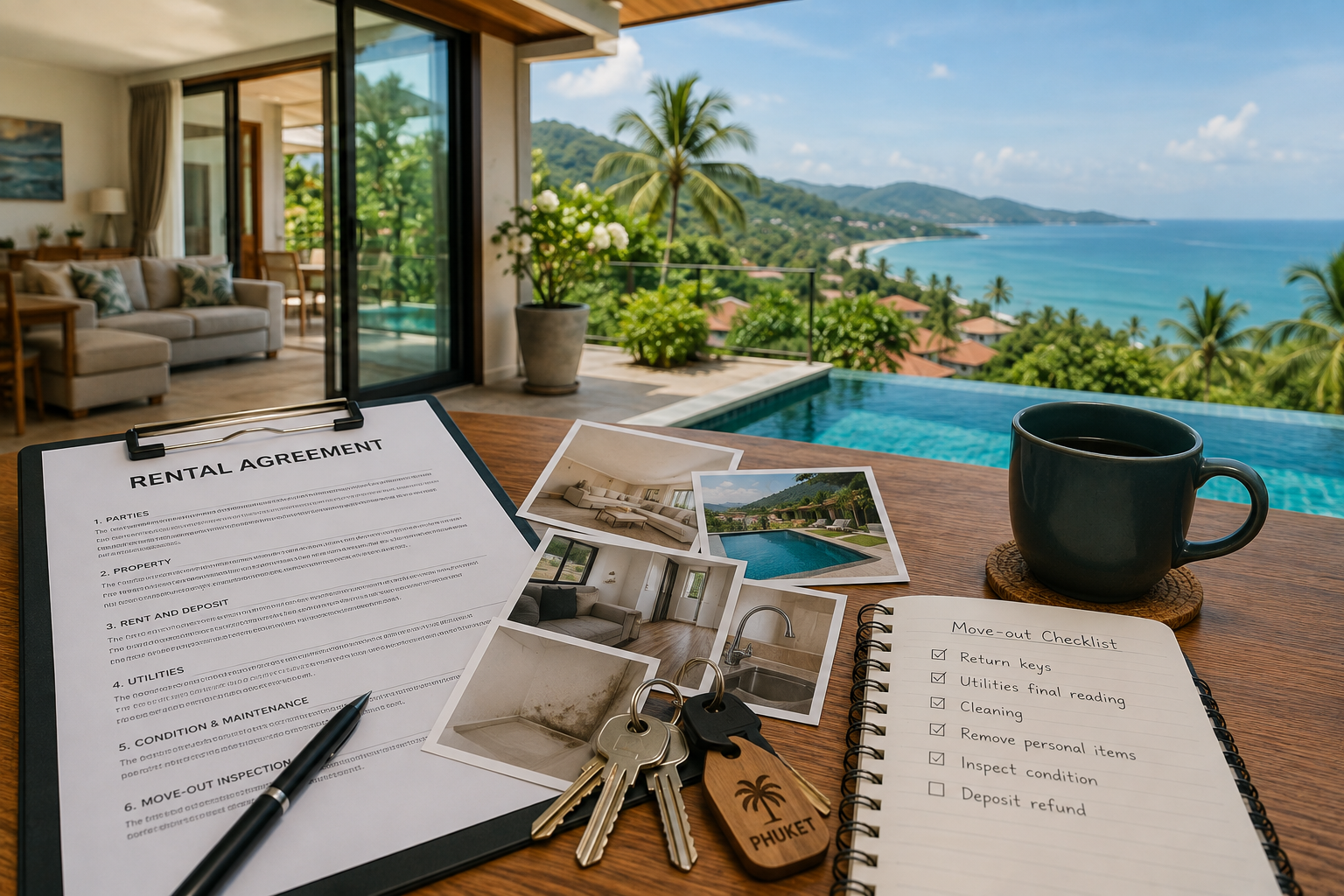
You pay the security deposit, move in, complete the tenancy and eventually return the keys.
Then the refund becomes complicated.
The agent says they are waiting for the owner.
The landlord says they need more time to calculate electricity or cleaning.
New damage claims appear.
Or you have already left Phuket and the messages simply stop.
For an expat renter, this can mean tens of thousands of baht sitting in somebody else's account while you try to solve the dispute remotely.
Before assuming the money is gone, work out exactly what your rental agreement, move-out condition and evidence actually support.
Phuket Deposits Can Represent Serious Money
Long-term Phuket rentals commonly involve substantial upfront payments.
A typical arrangement may involve advance rent together with a security deposit, although the exact structure depends on the property and agreement.
That becomes especially significant when the property is:
- a villa
- a larger family house
- a high-end condo
- a property in Rawai, Bang Tao, Kamala, Patong or other expensive rental areas
A deposit equal to multiple months of rent can easily represent tens of thousands of baht.
On a more expensive property, it can be much more.
That is why you should treat a deposit dispute like a financial claim rather than simply another unpleasant conversation with the agent.
Start With Your Actual Rental Agreement
Before arguing about what is “normal in Phuket,” read what you actually signed.
Look for clauses covering:
- security deposit amount
- deposit-return deadline
- permitted deductions
- utilities
- cleaning
- air-conditioning
- garden or pool maintenance
- furniture and appliances
- damage
- inventory
- move-out inspection
- notice period
- early termination
For villas in particular, responsibilities can extend beyond what you might expect in a simple condo lease.
Your agreement might address:
- pool servicing
- gardening
- pest control
- electricity
- water
- air conditioners
- appliances
- exterior areas
Do not assume responsibility just because the landlord sends you a bill.
First establish what the contract actually makes you responsible for.
Let Kleimit examine the actual clauses
Upload the rental contract and ask questions about your specific dispute.
For example:
- When should my Phuket deposit be returned?
- Can the landlord deduct this cleaning charge?
- Does my contract make me responsible for pool maintenance?
- What does the lease say about electricity?
- Am I responsible for this appliance?
- Which clauses matter for the damage claim?
Kleimit works from your own rental agreement, not from a generic Phuket lease found online.
Separate Every Deduction
Suppose the landlord gives you this after move-out:
Deep cleaning: ฿6,000
Pool cleaning: ฿4,500
Air-conditioner servicing: ฿5,000
Sofa damage: ฿18,000
Electricity: ฿9,000
Wall repainting: ฿12,000
That is not one ฿54,500 problem.
It is six claims.
For each one, ask:
- What exactly happened?
- Did you cause it?
- Was it already present?
- What does your lease say?
- Was the issue reported during the tenancy?
- Is there photographic evidence?
- Is there an invoice?
- Is the amount for repair or full replacement?
You may accept some deductions and dispute others.
That is often much stronger than simply demanding the entire deposit back.
Move-In Photos Matter Even More With Villas
A villa contains far more things that can later become disputed.
Think about:
- outdoor furniture
- swimming pools
- decking
- gardens
- gates
- kitchen equipment
- multiple air conditioners
- curtains
- appliances
- bathrooms
- walls
- windows
- furniture
If possible, preserve the condition of those areas when you move in.
Photos and videos can establish that:
- a sofa already had marks
- outdoor furniture was already weathered
- tiles were already cracked
- a wall had discoloration
- an appliance was old
- a cabinet was already swollen
- pool equipment already had problems
Without that evidence, both sides may later rely mainly on memory.
Phuket's Climate Can Become Part of the Dispute
Heat, humidity, heavy rain, salt air near the coast and ordinary aging can all affect a property over time.
That does not automatically make every problem normal wear and tear.
But it does mean the cause of deterioration matters.
Examples include:
- corrosion
- mold
- swollen wood
- fading outdoor furniture
- leaking windows
- deteriorating paint
- moisture damage
- appliance wear
If a landlord says:
“You damaged this.”
look for evidence of how the problem actually developed.
Maybe you reported a leak six months earlier.
Maybe photographs show gradual deterioration.
Maybe maintenance workers already inspected it.
Maybe the problem existed at move-in.
Your old messages can become extremely useful.
Don't Lose Your Maintenance Conversations
During a Phuket tenancy you may communicate with:
- the landlord
- an agent
- property management
- a pool company
- a gardener
- maintenance staff
- condominium management
Preserve important conversations.
If you reported:
“The bedroom AC is leaking again.”
or:
“Water is entering near the balcony door during heavy rain.”
that message can later help establish that the issue was not something first discovered when you moved out.
Kleimit can help connect the evidence
Instead of manually jumping between your contract, photographs and months of chat messages, keep the relevant material together.
For each deduction, work through:
Claim → contract → condition → messages → evidence → response
Be Careful When the Agent Is Only the Messenger
Agents play a large role in Phuket's rental market.
Sometimes the agent is extremely helpful.
Sometimes they simply relay messages:
“Owner says no.”“Owner wants ฿20,000.”“Owner says sofa must be replaced.”
The agent's message does not necessarily establish that the deduction is justified.
Ask for the underlying explanation.
If the landlord claims ฿20,000 for damage, you may want:
- a description of the damage
- photographs
- a quotation
- an invoice
- confirmation of what is actually being repaired
- the contractual basis for charging you
Stay polite with the agent.
They may actually become useful in persuading the owner once your position is properly documented.
What If You Leave Phuket Before the Deposit Is Returned?
This can happen easily.
Your lease ends on Friday.
Your flight leaves Thailand on Sunday.
The landlord says:
“Deposit will be calculated next week.”
Now you are thousands of kilometres away.
Before leaving, make sure you keep copies of:
- the signed contract
- deposit payment proof
- move-in photos
- move-out photos and videos
- inspection records
- utility readings
- key-return confirmation
- landlord details
- agent details
- refund bank details
- relevant messages
If possible, get the move-out condition and key return acknowledged in writing.
You want as few factual disputes as possible once you are overseas.
A Phuket Deposit Dispute Does Not Have to Stay Between You and the Landlord
Phuket has its own local consumer-protection route.
The Phuket Office of the Consumer Protection Board has confirmed that foreign tenants can submit complaints involving landlords who refuse to return deposits, inflate utility charges or breach rental agreements.
Local reporting says the office normally attempts mediation first. Tenants have also been advised to preserve contracts and evidence showing the property's condition.
According to the same report, complaints can be made through the Phuket OCPB office at Phuket Provincial Hall, the 1166 consumer hotline, or OCPB's official channels.
That does not mean every renter automatically wins.
Your position still depends on:
- the contract
- the facts
- the evidence
- which rules apply to the landlord
But it does mean that endlessly chasing an unresponsive owner is not necessarily your only option.
Not Every Thai Rental Protection Applies to Every Phuket Landlord
This distinction is important.
Thailand has consumer-protection rules applying to certain residential rental businesses.
But the regulatory position can depend on factors such as the landlord's rental activity and the type of agreement.
A person privately renting out one villa should not automatically be treated as legally identical to a professional operator managing numerous rental units.
So be careful with statements online such as:
“Thai law says every deposit must always be returned within X days.”
The first question is whether that particular rule actually applies to your tenancy.
Your contract may also contain its own refund deadline.
This is why Kleimit focuses first on what your actual documents say rather than pretending every Phuket rental operates under identical terms.
Don't Turn a Civil Dispute Into Something Worse
One widely reported Phuket rental dispute in 2025 escalated far beyond arguments over a deposit and resulted in serious property damage and police involvement.
Whatever the merits of a deposit disagreement, destroying property, threatening an owner or retaliating physically can transform a money dispute into a much more serious problem.
Keep the dispute boring.
Contract.
Evidence.
Numbers.
Written requests.
Formal escalation if necessary.
That is much more useful than anger.
Ask for Evidence Behind Expensive Replacement Claims
Suppose the owner says:
Sofa replacement: ฿35,000
Before accepting it, determine what is actually being claimed.
Useful questions include:
- What is damaged?
- Was it documented at move-in?
- How old is the sofa?
- Can it be repaired?
- Is it actually being replaced?
- Is there a quotation?
- Does the contract make you responsible?
The same principle applies to:
- mattresses
- appliances
- televisions
- glass doors
- pool equipment
- outdoor furniture
- air conditioners
The replacement price alone does not establish your responsibility.
Build a Simple Timeline
Before escalating a Phuket deposit dispute, write down:
Move-in date
Deposit paid
Existing defects
Important maintenance reports
Notice date
Move-out date
Inspection
Keys returned
Landlord's claimed deductions
Contractual refund deadline
Refund promised
Follow-ups
Current unpaid balance
This forces the dispute into a factual structure.
It also makes it much easier for a third party to understand.
Prepare One Clear Response
Once you understand the claims, avoid sending fifteen fragmented messages.
A useful response can identify:
- what amount is being held
- which deductions you accept
- which deductions you dispute
- why you dispute them
- which evidence supports you
- what your contract says
- what amount you are requesting
- when you expect a response
Kleimit can help prepare it
Once your contract and evidence are inside your case, you can ask Kleimit to help organize the position and draft the communication you want to send.
If the situation later requires something more formal, Kleimit can also generate a PDF notice.
You decide what gets sent.
DIY vs. Kleimit
Doing it yourself
Read the entire rental contract.
Identify every relevant clause.
Go through move-in photographs.
Go through move-out photographs.
Search your LINE and WhatsApp history.
Organize maintenance conversations.
Check every landlord deduction.
Find invoices and quotations.
Build a timeline.
Draft a response.
Review everything again.
Using Kleimit
Upload your rental contract.
Add the relevant evidence.
Let the AI analyze the case.
Ask questions about individual deductions.
Work through your contract and evidence in one place.
Prepare your landlord or agent response.
Generate a PDF notice if you need something more formal.
$7. One case. One-time payment.
Don't Write Off Your Phuket Deposit Without Examining the Claims
Some deductions are legitimate.
Others may be unsupported, exaggerated or inconsistent with the rental agreement.
The important question is not simply whether the landlord refuses to pay.
It is:
What do your contract and evidence actually support?
Before walking away from tens of thousands of baht, make sure you understand your position.
Kleimit is an AI assistant for rental deposit disputes throughout Thailand. It is not a law firm and does not provide legal advice.