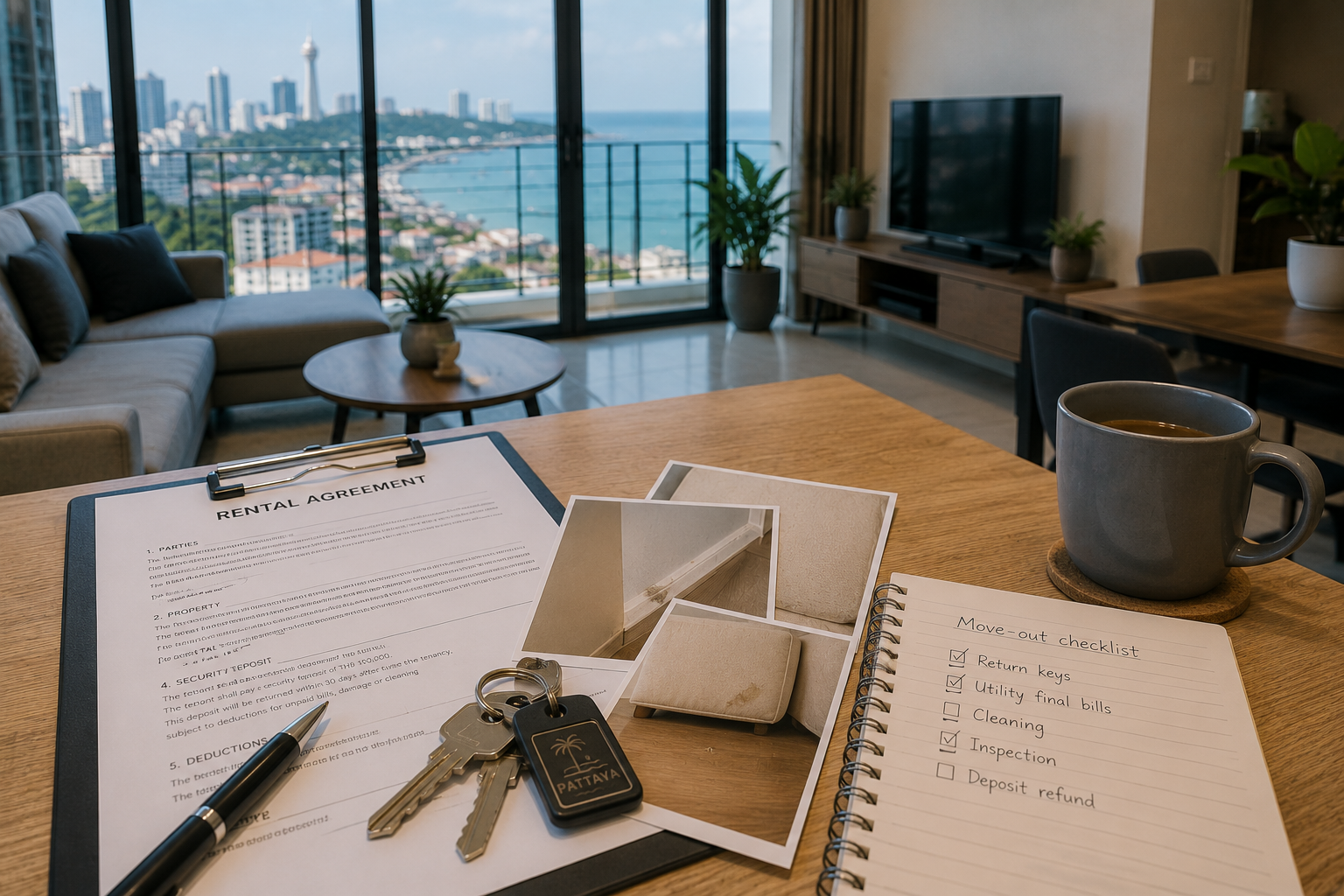
The inspection is finished.
The keys are returned.
The landlord tells you they will calculate any final cleaning or utility costs and send the remaining security deposit.
Then nothing arrives.
The agent says they are waiting for the owner.
The owner stops answering.
Or new repair charges suddenly appear after you have already left.
For foreign renters in Pattaya, that can mean tens of thousands of baht trapped in a dispute while you may already be outside Thailand.
A recent renter in Nong Prue described paying a ฿100,000 security deposit on a Pattaya house. After the move-out walkthrough, the renter said the landlord would deduct necessary cleaning and transfer the remainder to a US bank account. According to the renter, the deposit was never returned.
Before giving up on your money, work out exactly what your lease and evidence support.
Start With the Rental Contract
The most important question is not:
“Is my landlord being unfair?”
It is:
“What did the agreement actually say should happen to my deposit?”
Look for terms covering:
- the security deposit amount
- when the deposit should be returned
- permitted deductions
- cleaning obligations
- utility bills
- damage and repairs
- move-out inspection
- notice periods
- early termination
- key return
- inventory and furniture
The relevant clauses may be scattered throughout the agreement.
That becomes especially important when the landlord says one thing after move-out while your contract appears to say something different.
Let Kleimit check your actual lease
Instead of trying to interpret every clause yourself, upload the contract to Kleimit.
You can ask questions such as:
- When should my deposit be returned?
- What deductions does my lease actually allow?
- Does the contract make me responsible for this repair?
- What does it say about cleaning?
- Did I satisfy the notice requirement?
- Which clauses support my position?
Kleimit works from your own rental agreement rather than a generic Pattaya contract found online.
A Walkthrough Does Not End the Evidence Trail
A move-out inspection can be extremely useful.
If the landlord or agent walks through the property with you and does not identify major damage, preserve any evidence of that inspection.
That could include:
- photographs
- video
- messages confirming the walkthrough
- inspection forms
- key-return acknowledgement
- messages saying the deposit will be transferred
- statements about what will be deducted
This matters if substantial new damage claims suddenly appear afterward.
A recent Pattaya renter said they completed a walkthrough with the landlord before being told the remaining balance of a ฿100,000 deposit would be transferred after cleaning costs were calculated.
A written record of what happened at handover can become extremely important if the story later changes.
Don't Treat the Whole Deposit as One Argument
Suppose the landlord says:
Cleaning: ฿4,000
Air conditioner: ฿3,500
Wall damage: ฿12,000
Furniture: ฿15,000
Utilities: ฿4,500
Don't immediately argue about the total.
Treat each deduction separately.
For every item ask:
- What exactly is being claimed?
- Did you cause it?
- Was it already present?
- What does the contract say?
- Is there a photograph?
- Is there an invoice or quotation?
- Did you report the problem earlier?
- Does the amount relate to an actual repair?
Some deductions may be perfectly legitimate.
Others may be difficult for the landlord to justify.
The point is to find out which is which.
Your Pattaya Rental Evidence May Be Spread Everywhere
This is where disputes become tedious.
You might have:
- a 12-page lease
- photographs from move-in
- photographs from move-out
- LINE conversations
- WhatsApp messages with an agent
- transfer receipts
- utility bills
- an inventory
- repair quotations
- inspection messages
Individually, those documents may not tell the whole story.
Together, they can.
Kleimit helps connect the pieces
Upload the lease and relevant evidence into one case.
Then work through specific questions:
Landlord claim: damaged sofa
Contract: what does the damage clause say?
Evidence: what did the sofa look like at move-in?
Messages: was the issue previously reported?
Then move on to the next claim.
Upload your lease and evidence to Kleimit and work through your Pattaya deposit dispute for $7.
What If the Landlord Simply Stops Responding?
Repeatedly sending:
“Any update?”
usually becomes less useful with every repetition.
Once the contractual refund period has passed, a clearer communication generally identifies:
- the property
- when the tenancy ended
- when possession was returned
- the amount of deposit held
- deductions you accept
- deductions you dispute
- evidence supporting your position
- the balance you believe remains due
- a clear request for payment
Keep the communication factual.
You are trying to create a clear record of the dispute, not win an argument over LINE.
Don't Send an Angry Threat
A large withheld deposit can make this very personal.
Particularly if you're leaving Pattaya or Thailand soon.
But messages such as:
“Return my money or I'll destroy your business online.”
can turn a straightforward contractual dispute into something much messier.
A stronger approach is:
contract → evidence → amount disputed → clear request → reasonable escalation.
If the owner has a weak position, you generally want the written record to make that obvious.
What If You Have Already Left Thailand?
This is a common expat problem.
Your tenancy ends because you're:
- returning home
- changing jobs
- moving to another Thai city
- ending a retirement stay
- continuing your travels
Then the deposit problem appears after you have left.
Being overseas makes practical enforcement more inconvenient, but it does not make your contract, bank transfers, photographs or conversations disappear.
This is another reason to organize everything digitally before escalating.
If you know you will leave Thailand immediately after move-out, make sure you preserve:
- the signed lease
- landlord/agent contact details
- proof of the deposit
- move-out evidence
- bank details supplied for repayment
- written confirmation of key return
- all relevant messages
Pattaya Tourist Police Have Assisted Foreign Renters With Deposit Disputes
In August 2026, Pattaya Tourist Police reported assisting a Ukrainian tenant who approached officers after being unable to recover a house rental deposit.
Police used an interpreter, explained procedures available under the rental agreement and advised the renter about pursuing the dispute through appropriate legal channels.
That does not mean Tourist Police will recover every deposit or decide every civil dispute.
But it does show that a foreign renter in Pattaya is not necessarily limited to endlessly messaging the landlord.
Depending on the facts, possible escalation may include consumer-protection channels, legal assistance or other appropriate Thai procedures.
Kleimit does not replace those authorities.
It helps you get your contract, facts and evidence organized before you decide whether escalation is worthwhile.
Agents Can Help, but the Deposit Dispute Is Still Yours
Pattaya's rental market relies heavily on property agents.
A good agent may:
- communicate with the owner
- attend inspections
- translate
- explain what the landlord wants
- help negotiate deductions
- push an owner to respond
But an agent saying:
“The owner insists.”
does not tell you whether the landlord's position is supported by your contract.
If the deposit is being withheld, keep asking for the underlying reason and evidence rather than arguing indefinitely through the intermediary.
What If the Deposit Is Huge?
Pattaya rentals range from inexpensive studios to large houses and villas.
That means the amount at stake can vary enormously.
When a deposit is ฿10,000, a renter may decide that prolonged escalation is not worth the effort.
At ฿50,000 or ฿100,000, the calculation may look very different.
And the larger the amount becomes, the more useful it is to have the dispute organized clearly before deciding what to do next.
Spending $7 to understand a dispute involving tens of thousands of baht can be a relatively small part of that decision.
Build the Case Before Escalating It
Before contacting authorities, lawyers or sending a final demand, create a simple factual timeline:
Move-in date
Deposit paid
Important maintenance events
Notice given
Move-out inspection
Keys returned
Landlord's deductions
Promised refund date
Follow-up messages
Current unpaid balance
Then connect each disputed claim with the relevant contract term and evidence.
That gives anyone looking at the dispute something much easier to understand.
Kleimit can help prepare the response
Once your rental contract and evidence are in your case, you can use the AI assistant to help prepare the communication you want to send.
You remain in control of what actually gets sent.
Kleimit helps with the annoying work before that point: reviewing the documents, identifying relevant terms and organizing the argument.
DIY vs. Kleimit
Doing it yourself
Read the whole lease.
Find every deposit and damage clause.
Search old LINE conversations.
Organize move-in and move-out photos.
Compare each deduction.
Work out which claims the evidence supports.
Create a timeline.
Draft the response.
Check everything again.
Using Kleimit
Upload your rental contract.
Add the relevant evidence.
Let the AI analyze the case.
Ask questions about individual deductions.
Work through your contract and evidence in one place.
Prepare your landlord or agent response.
Generate a PDF notice if you need something more formal.
$7. One case. One-time payment.
Don't Abandon Your Pattaya Deposit Without Checking the Case
A landlord holding your money does not automatically mean the landlord is entitled to keep it.
But neither is every deduction automatically unfair.
The useful question is:
What do the contract and evidence actually show?
Before writing off thousands, or tens of thousands, of baht, organize the dispute properly.
Kleimit is an AI assistant for rental deposit disputes throughout Thailand. It is not a law firm and does not provide legal advice.