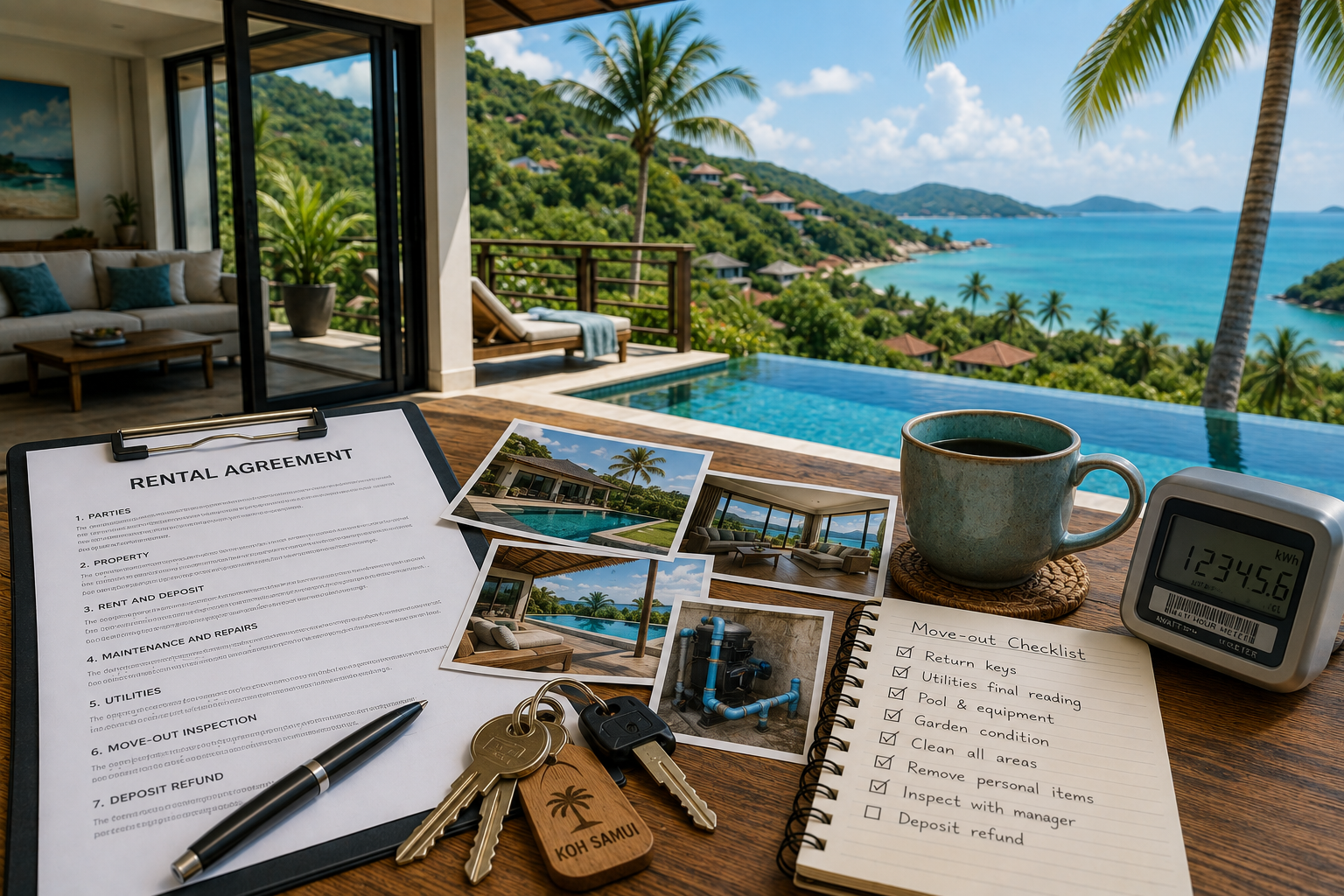
You pay a substantial security deposit, live there for six months or a year, and eventually move out.
Then the deposit becomes complicated.
The property manager says the owner needs to inspect the villa.
The landlord claims something around the pool was damaged.
There is a garden bill.
An air-conditioner needs servicing.
A piece of furniture apparently has to be replaced.
The electricity calculation is unclear.
Or the owner simply becomes difficult to reach once you leave the island.
Before writing off the money, work out what your rental agreement, property condition and evidence actually support.
Samui Rental Deposits Can Become Very Large
Koh Samui has everything from relatively inexpensive apartments to high-end sea-view villas.
That means security deposits can vary enormously.
Current Samui rental guides commonly describe long-term arrangements involving one or two months' security deposit, while some properties ask for more depending on the tenancy, pets or other circumstances.
Consider a villa renting for ฿70,000 per month.
A two-month deposit means ฿140,000 of your money is sitting with the landlord.
At that point, a deposit dispute is not a minor inconvenience.
It is a meaningful financial claim.
Start With Your Actual Rental Agreement
Before discussing whether something is “normal on Samui,” establish what you actually agreed to.
Look for clauses covering:
- security deposit
- refund timing
- permitted deductions
- rent and advance payments
- electricity
- water
- pool maintenance
- garden maintenance
- air-conditioning
- cleaning
- furniture and appliances
- pest control
- repairs
- move-out inspection
- inventory
- notice period
- early termination
- key return
Villa agreements can contain far more maintenance provisions than an ordinary condo lease.
That makes the exact wording particularly important.
Let Kleimit examine the real contract
Upload your rental agreement and ask questions about the actual clauses.
For example:
- When should my deposit be returned?
- Does my lease make me responsible for pool repairs?
- Is garden maintenance included in the rent?
- Can the landlord charge me for this AC problem?
- What does my contract say about electricity?
- Does the lease support this furniture deduction?
- What notice period did I agree to?
Pool Maintenance and Pool Damage Are Not Necessarily the Same Thing
This is one of the most important distinctions in a villa rental.
Your lease might say you are responsible for keeping the pool maintained.
But what exactly does that mean?
It could refer to:
- ordinary cleaning
- chemicals
- routine servicing
That does not automatically answer who pays when:
- a pump fails
- a filter needs replacing
- tiles crack
- the lighting system stops working
- old equipment reaches the end of its life
Some Samui rentals explicitly include pool and garden maintenance in the rent, while others allocate those expenses differently.
Never assume.
Check the agreement.
The Same Applies to Gardens
Villa gardens can generate surprisingly large deductions.
A landlord might claim:
Garden restoration: ฿12,000
Damaged plants: ฿8,000
Irrigation repair: ฿6,500
Before accepting that, establish:
- what condition the garden was in at move-in
- who was responsible for regular gardening
- whether a gardener was already provided
- whether the problem developed gradually
- whether irrigation equipment failed
- what the lease actually required you to do
A tropical garden naturally changes over a year.
That does not mean tenants can neglect it, but it also does not mean every landscaping expense belongs to the tenant.
Samui's Climate Can Complicate Damage Claims
Island properties face environmental conditions that can be hard on buildings and furniture:
- humidity
- heavy rain
- intense sun
- salt air
- mold
- corrosion
- moisture
- insects
- outdoor wear
A metal fixture near the coast may deteriorate differently from the same fixture in an indoor Bangkok condo.
Outdoor furniture may fade.
Wood can react to humidity.
Paint can deteriorate.
Air conditioners work hard.
None of those automatically proves that a deduction is unfair.
But it does mean you should ask:
Was this deterioration actually caused by me?
Useful evidence can include:
- move-in photographs
- maintenance requests
- reports of leaks
- repair visits
- photographs taken throughout the tenancy
- previous messages about corrosion or mold
Move-In Photos Matter More in a Villa
A furnished villa may contain hundreds of items.
You could later be blamed for:
- sofas
- mattresses
- tables
- televisions
- kitchen appliances
- artwork
- curtains
- outdoor furniture
- pool equipment
- sun loungers
- decorative items
- cookware
When possible, photograph the property carefully at move-in.
And keep the inventory if one exists.
If a sofa already had a stain or an outdoor chair was already weathered, a dated photograph may become far more useful than an argument a year later.
Keep Your Maintenance Conversations
Suppose the landlord later claims:
“You damaged the bedroom wall with moisture.”
But five months earlier you sent the property manager:
“Water is coming through this wall whenever there is heavy rain.”
That conversation matters.
The same applies if you previously reported:
- leaking air conditioners
- pool equipment problems
- plumbing
- mold
- roof leaks
- damaged appliances
- water pumps
- pest problems
- electrical issues
A maintenance message can help establish that a problem existed long before move-out.
Kleimit can help connect the evidence
A Samui villa dispute may involve:
lease + inventory + photographs + property-manager messages + maintenance records + invoices + deduction list
Instead of manually trying to remember which document relates to which problem, examine each claim separately.
Upload your lease and evidence to Kleimit and work through your Koh Samui deposit dispute for $7.
Electricity Bills Deserve Special Attention
Electricity can be significant in an island villa because of:
- several air conditioners
- swimming-pool equipment
- water pumps
- large refrigerators
- electric water heaters
- other equipment
Samui rental guides specifically advise tenants to check how electricity is charged, because arrangements vary and some managed properties charge differently from direct utility billing.
Before accepting a final deduction, check:
- the meter reading
- the billing period
- the rate used
- whether the lease specifies that rate
- whether the amount corresponds to your actual occupancy
- whether another charge has been added
If the landlord simply says:
“Electricity ฿14,000.”
ask for the calculation.
Property Managers Can Create Another Layer
On Samui, you may rarely communicate directly with the owner.
Instead you deal with:
- an estate agent
- villa manager
- property-management company
- maintenance manager
This can create confusion when the deposit is withheld.
The manager says:
“Owner decided.”
The owner says:
“Ask management.”
You need to establish:
- who holds the deposit
- who signed the rental contract
- who has authority to approve deductions
- who actually received your payment
Check the contract and bank transfer rather than assuming the person sending WhatsApp messages controls the money.
What If the Owner Lives Overseas?
Samui has plenty of properties owned by people who do not live permanently on the island.
That can make communication slower.
It can also mean the owner relies heavily on whatever the property manager reports.
If the manager says:
“Tenant damaged furniture.”
an overseas owner may simply accept that.
That makes clear evidence even more important.
A structured response showing:
landlord claim → contract → photograph → maintenance history → your position
is much easier for an owner to evaluate than twenty emotional chat messages.
Don't Accept an Expensive Replacement Claim Without Understanding It
Imagine the landlord claims:
Outdoor sofa replacement: ฿45,000
Ask:
- What exactly is damaged?
- How old was the sofa?
- Was the condition documented at move-in?
- Can it be repaired?
- Does it actually need replacing?
- Is there a quotation?
- Is there an invoice?
- Does the contract make you responsible?
The same applies to:
- televisions
- mattresses
- air conditioners
- pool pumps
- refrigerators
- outdoor furniture
- glass doors
- kitchen equipment
A large replacement price does not by itself establish tenant responsibility.
Separate Every Deduction
Suppose the final list says:
Deep cleaning: ฿6,000
Pool damage: ฿18,000
Garden restoration: ฿12,000
Outdoor sofa: ฿25,000
Air conditioner: ฿8,000
Electricity: ฿11,500
Do not treat it as one ฿80,500 argument.
Treat it as six individual claims.
For each one:
Contract
What did you agree to?
Condition
What was the item like before?
Cause
What actually happened?
Evidence
What do photos and messages show?
Amount
What supports the price being claimed?
Then decide whether you:
- accept the deduction
- partly dispute it
- completely dispute it
That creates a much stronger position.
What If You Have Already Left the Island?
This is particularly important on Samui.
People often leave immediately after finishing a rental.
Your next stop might be:
- Bangkok
- Phuket
- another country
- home
Then the landlord begins discussing deductions after you are already gone.
Before leaving Samui, preserve:
- signed rental agreement
- proof of deposit
- inventory
- move-in photographs
- move-out photographs
- walkthrough video
- final meter readings
- key-return confirmation
- maintenance messages
- landlord information
- property-manager information
- bank details supplied for the refund
If possible, get written confirmation that the property and keys were handed back.
Thailand's 2025 Rental Rules May Matter, but Check the Landlord
Thailand introduced new controlled-contract rules for residential rental businesses that took effect on 4 September 2025. OCPB says covered businesses must use appropriate rental contracts and, where inspection finds no tenant-caused damage, return the deposit within seven days after the tenancy ends.
But this is crucial:
Do not assume every privately owned Samui villa automatically falls under exactly the same controlled-business requirements.
The status of the landlord and rental operation matters.
A private owner renting one holiday home may be in a different position from a professional operator running multiple residential rentals.
Your own lease also remains extremely important.
OCPB Is an Escalation Option
If the dispute cannot be resolved directly, Thailand's Office of the Consumer Protection Board provides consumer complaint channels.
OCPB currently lists:
- its online complaint system
- the OCPB Connect application
- hotline 1166
- LINE @ocpbconnect
for consumer complaints and enquiries.
That does not guarantee that OCPB will decide every private villa dispute in your favour.
But it means an unresponsive landlord is not necessarily the end of the road.
Before escalating, organize the evidence.
Build a Clear Timeline
Write down:
Move-in date
Deposit paid
Inventory
Existing defects
Important maintenance reports
Notice given
Move-out date
Inspection
Keys returned
Final meter readings
Deductions claimed
Refund promised
Current unpaid balance
That gives you a clear picture of the dispute before you send a serious demand or involve somebody else.
Keep the Response Factual
It is understandable to be angry if someone is holding ฿100,000 or more of your money.
But your written position is stronger when it stays boring.
For each contested deduction:
What is claimed
Why you dispute it
What the contract says
What evidence supports you
Then state the balance you believe should be returned and ask for a clear response.
Kleimit can help prepare that response
Once your lease and evidence are in the case, Kleimit can help you organize the claims and draft the communication you want to send to the landlord or property manager.
If something more formal becomes necessary, you can also generate a PDF notice.
You decide what gets sent.
DIY vs. Kleimit
Doing it yourself
Read the full villa contract.
Identify all maintenance clauses.
Review the inventory.
Compare move-in photos.
Compare move-out photos.
Search months of WhatsApp or LINE messages.
Find maintenance records.
Check electricity calculations.
Review invoices.
Analyze every deduction.
Build a timeline.
Draft your response.
Using Kleimit
Upload your rental contract.
Add the relevant evidence.
Let the AI analyze the case.
Ask questions about individual deductions.
Work through your contract and evidence together.
Prepare your landlord or property-manager response.
Generate a PDF notice if needed.
$7. One case. One-time payment.
Don't Walk Away From a Large Samui Deposit Without Checking the Case
Some villa deductions are legitimate.
Some may relate to genuine tenant damage.
Others may involve aging equipment, tropical deterioration, unclear maintenance responsibilities or unsupported replacement costs.
The important question is not:
“The owner says I owe it, so what can I do?”
It is:
“What do my contract and evidence actually support?”
When tens or even hundreds of thousands of baht may be involved, it is worth finding out.
Kleimit is an AI assistant for rental deposit disputes throughout Thailand. It is not a law firm and does not provide legal advice.