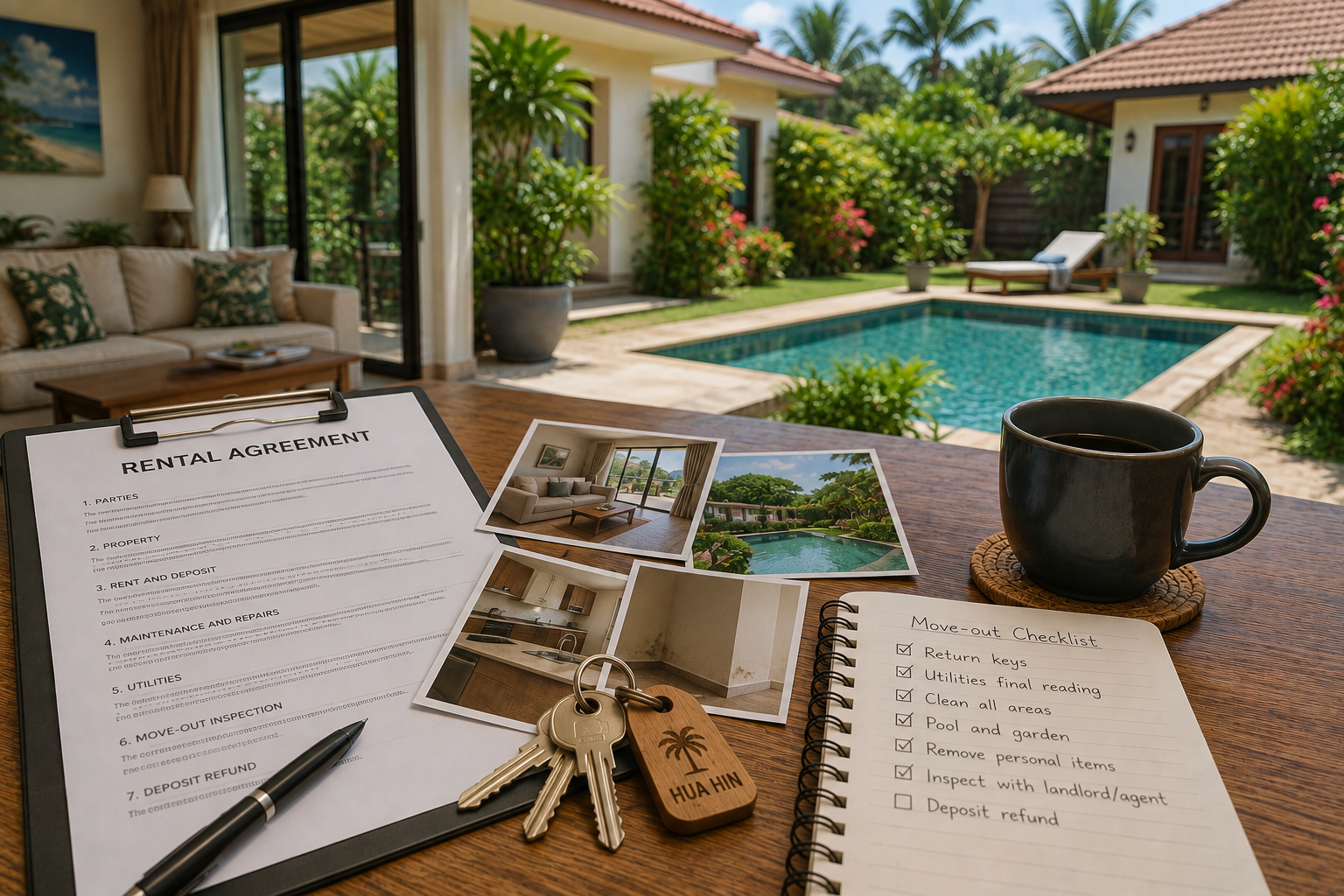
You give notice, clean the property, settle the bills and return the keys.
Then the deposit refund starts becoming complicated.
The landlord says they need to inspect the property again.
The agent says they are waiting for the owner.
A maintenance bill appears.
Then a cleaning charge.
Then a claim about furniture, the garden, pool equipment or something else that has been there for years.
Or nobody gives you a clear answer at all.
Before accepting that your deposit is gone, work out what your rental agreement, property condition and evidence actually support.
Hua Hin Has a Different Rental Profile From Bangkok
Hua Hin has everything from small condos near town and Khao Takiab to houses and private pool villas further inland.
Long-term rental guides currently describe one- to two-month deposits as common, while villas can involve considerably larger monthly rents and therefore much larger amounts being held as security.
That matters when a move-out dispute begins.
On a ฿12,000 condo, a disputed deposit hurts.
On a ฿40,000 or ฿60,000 house, the amount at stake can become substantial very quickly.
Start With the Contract
Do not begin with:
“My landlord says this is normal in Hua Hin.”
Begin with:
“What did I actually agree to?”
Check the rental agreement for clauses covering:
- security deposit
- refund timing
- permitted deductions
- notice period
- early termination
- cleaning
- furniture
- appliances
- air-conditioning
- utilities
- garden maintenance
- pool maintenance
- pest control
- repairs
- move-out inspection
- inventory
- key return
With houses and villas, these responsibilities can become particularly important.
A condo tenant may mainly worry about the interior.
A villa tenant might also have contractual responsibilities involving:
- swimming pools
- gardens
- pumps
- outdoor furniture
- gates
- irrigation
- air conditioners
- exterior areas
Do not assume that every maintenance bill is automatically yours.
First establish what the agreement actually says.
Let Kleimit examine the real lease
Upload your rental agreement and ask questions about your specific situation.
For example:
- When should my deposit be returned?
- Does my contract make me responsible for pool maintenance?
- Can the landlord charge me for this repair?
- What does the lease say about garden maintenance?
- Does it require professional cleaning?
- Which clauses support this deduction?
Kleimit works from your actual rental agreement rather than generic Hua Hin rental advice.
Maintenance Responsibility Is a Major Source of Disputes
Local Hua Hin rental guidance specifically warns about unclear maintenance responsibility leading to disagreements between landlords and tenants.
Imagine you rent a house with a pool.
Six months later, the pool pump develops a problem.
The landlord says:
“Tenant must maintain pool.”
But does “maintain” mean paying for regular cleaning?
Replacing filters?
Repairing a broken pump?
Replacing equipment that failed because of age?
Those are not necessarily the same obligation.
The same problem can arise with:
- air conditioners
- refrigerators
- washing machines
- water pumps
- garden equipment
- plumbing
- electrical systems
- furniture
Read the wording carefully before accepting responsibility.
Long Tenancies Make Wear and Damage Harder to Separate
Hua Hin attracts plenty of longer-term renters, and that creates a predictable question at move-out:
Did you damage the property, or did the property simply age while you lived there?
Imagine living in the same house for three years.
During that time:
- paint fades
- outdoor furniture weathers
- metal develops corrosion
- cabinet hinges loosen
- curtains age
- appliances accumulate wear
- wood reacts to humidity
- garden surfaces deteriorate
None of that automatically proves the landlord cannot deduct anything.
But neither does a worn item automatically prove tenant damage.
Useful questions include:
- How old was the item?
- What did it look like at move-in?
- How long did you live there?
- Was there a specific damaging event?
- Did you report the issue earlier?
- What does the lease say?
- Is the landlord repairing it or replacing it?
Context matters.
Your Move-In Photos Can Become Extremely Valuable
A landlord's move-out photograph proves what something looks like now.
It does not necessarily prove what it looked like when you arrived.
That is why move-in evidence matters.
Look for photographs or videos showing:
- furniture condition
- walls
- flooring
- appliances
- bathrooms
- outdoor furniture
- pool condition
- garden condition
- existing rust
- cracked tiles
- cabinet damage
- stains or scratches
If you rented a furnished villa, there may be dozens of items that could later become disputed.
Preserve whatever evidence you have.
What If You Never Took Formal Move-In Photos?
You may still have useful evidence.
Search:
- phone photos
- videos sent to friends
- property listing photographs
- agent messages
- maintenance conversations
- inspection records
- old Facebook or Instagram photos taken inside the property
- photographs where the disputed item appears in the background
Evidence does not need to have been created specifically for a deposit dispute to be useful later.
Keep Your Maintenance Messages
Suppose the landlord says you damaged a cabinet.
But eight months earlier you sent:
“The cabinet under the sink is swelling again because water keeps leaking.”
That changes the discussion.
Or perhaps you reported:
“The pool pump is making a strange noise.”“The bedroom AC is leaking.”“Water is entering during heavy rain.”“This chair was already loose when we moved in.”
Those conversations can help establish when a problem began and whether the landlord already knew about it.
Kleimit can help connect the pieces
A deposit dispute may involve:
contract + inventory + photos + maintenance messages + landlord deductions + invoices
Instead of trying to reconstruct everything from memory, organize it around each individual claim.
Pool and Garden Charges Need to Be Examined Carefully
This is particularly relevant to Hua Hin houses and villas.
Some rentals include regular pool and garden service.
Others make the tenant responsible.
Others split responsibility.
For example, your landlord may pay the pool company while you pay electricity and water.
Or the lease might require you to keep the garden maintained while the owner remains responsible for major equipment.
The exact arrangement can vary enormously.
So if you receive:
Pool repair: ฿12,000
Garden restoration: ฿8,000
Pump replacement: ฿15,000
do not assume the words “pool maintenance” somewhere in the contract automatically justify all ฿35,000.
Work through each claim.
Separate Every Deduction
Suppose the landlord proposes:
Cleaning: ฿4,000
Garden restoration: ฿6,000
Pool repair: ฿10,000
Sofa damage: ฿8,000
AC servicing: ฿5,000
Utilities: ฿3,500
That is six separate questions.
For each one ask:
- What exactly is being claimed?
- Does the contract make me responsible?
- What caused the problem?
- Was it documented at move-in?
- Did I previously report it?
- Is there an invoice or quotation?
- Is the item actually being repaired?
- Does the amount make sense?
Some deductions might be legitimate.
Some might be partially justified.
Some may have little support at all.
You do not need to take an all-or-nothing position.
Cleaning Should Not Be a Mystery Charge
A cleaning deduction may be reasonable where the property was left unusually dirty or where the contract clearly imposes a cleaning obligation.
But if the landlord simply says:
“Cleaning ฿5,000.”
you can still ask what that represents.
Useful questions include:
- What required cleaning?
- Was professional cleaning required by the lease?
- Was cleaning already included elsewhere?
- Is there an invoice?
- Was the house left materially dirtier than ordinary move-out condition?
The same principle applies to air-conditioner cleaning or servicing.
Check the contract before accepting a fixed charge simply because someone describes it as “standard.”
Private Owners Can Make Enforcement More Personal
A substantial part of Hua Hin's rental supply consists of houses, condos and villas belonging to individual owners rather than large institutional landlords.
That can make rental relationships very informal.
Sometimes that is great.
You deal directly with the owner and problems get solved quickly.
Sometimes it becomes difficult at move-out because the landlord treats the deposit almost as though it were discretionary.
Your strongest protection is not whether the owner seems friendly.
It is having:
- a clear contract
- payment records
- photographs
- maintenance history
- inspection evidence
- written communication
A friendly relationship is useful.
Documentation is better.
Don't Assume Every Thai Rental Rule Applies to Every Hua Hin Landlord
Thailand strengthened protections for tenants under controlled residential-leasing rules that came into effect in 2025.
But those rules have a defined scope.
A private person renting one house or condo should not automatically be treated as legally identical to a landlord operating multiple residential rental units.
This distinction matters particularly in a market like Hua Hin with many privately owned houses and villas.
So be cautious when reading claims online such as:
“Thai law says every landlord must return every deposit within exactly X days.”
First establish whether that particular rule applies to your landlord and tenancy.
Your own contract may also contain a specific refund deadline.
If the Agent Disappears, Identify Who Actually Holds the Deposit
Local Hua Hin rental guides also warn about agents who become difficult to reach after the deal has been completed.
That raises an important question:
Who actually received your deposit?
Was it:
- the landlord?
- the agent?
- the agency?
- a property management company?
Check:
- your bank transfer
- deposit receipt
- lease
- LINE messages
- booking agreement
Do not automatically chase the wrong person.
An agent may have arranged the tenancy without actually holding the deposit.
What If You Have Already Left Hua Hin?
Hua Hin has many expats who eventually:
- return home
- move back to Bangkok
- relocate elsewhere in Thailand
- travel after finishing the tenancy
That means the deposit dispute may start just as you are leaving town.
Before departure, preserve:
- signed lease
- proof of deposit
- move-in evidence
- move-out evidence
- utility readings
- receipts
- inventory
- maintenance messages
- landlord contact details
- agent details
- written confirmation that keys were returned
- bank details supplied for the refund
You want the dispute to remain manageable even if you are no longer standing in Hua Hin.
Build a Factual Timeline
Before sending a serious demand, write down:
Move-in date
Deposit paid
Existing defects
Important maintenance reports
Notice given
Move-out inspection
Keys returned
Final utility readings
Landlord's deductions
Refund promised
Follow-up messages
Balance still unpaid
This turns an emotional dispute into something another person can understand quickly.
One Structured Reply Is Better Than Twenty Frustrated Messages
After the landlord has explained the deductions, organize your response.
For each contested item:
Claim
What the landlord wants to deduct.
Contract
What the relevant clause actually says.
Evidence
Photos, messages, inventory or receipts supporting your position.
Position
Why you accept or dispute the deduction.
Then state clearly how much of the deposit you believe should be returned.
Kleimit can help prepare that response
Once your contract and evidence are in your Kleimit case, you can ask the AI assistant to help organize the dispute and prepare the communication you want to send.
If you later need something more formal, Kleimit can generate a PDF notice as well.
You decide what gets sent.
DIY vs. Kleimit
Doing it yourself
Read the entire rental contract.
Identify every maintenance obligation.
Review the inventory.
Find move-in photos.
Find move-out photos.
Search months or years of messages.
Check every deduction.
Find invoices and quotations.
Work out which claims you accept.
Build a timeline.
Write your response.
Review everything again.
Using Kleimit
Upload your rental contract.
Add the relevant evidence.
Let the AI analyze the case.
Ask questions about individual deductions.
Work through the contract and evidence together.
Prepare your landlord or agent response.
Generate a PDF notice if you need something more formal.
$7. One case. One-time payment.
Don't Give Up Your Hua Hin Deposit Without Checking the Claims
Some landlord deductions are legitimate.
Others may involve aging property, unclear maintenance obligations or unsupported charges.
The useful question is not simply:
“Will the landlord give me my money back?”
It is:
“What do my contract and evidence actually show?”
Before writing off thousands or tens of thousands of baht, understand the dispute properly.
Kleimit is an AI assistant for rental deposit disputes throughout Thailand. It is not a law firm and does not provide legal advice.