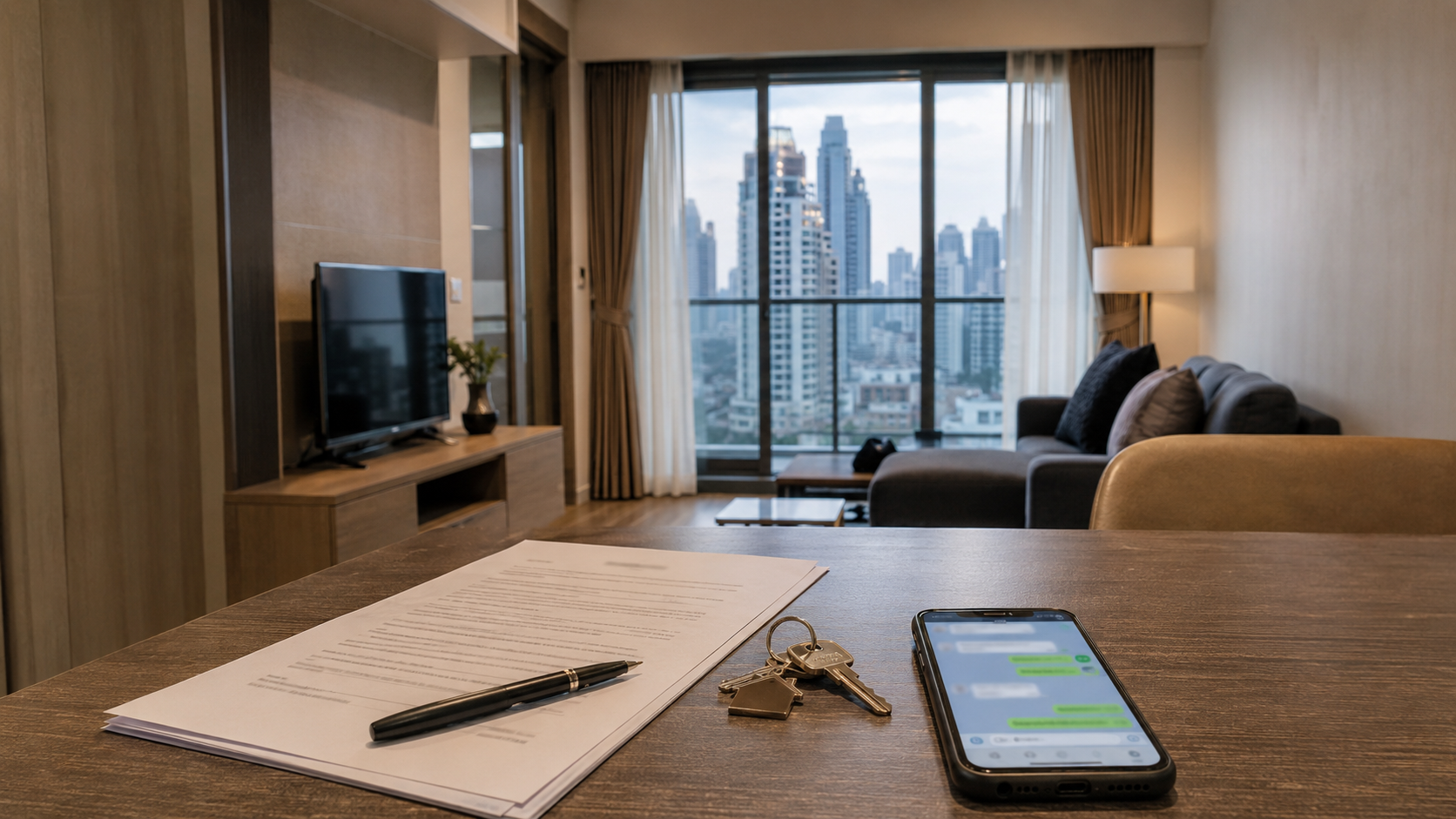
Instead, the agent keeps telling you they are “checking with the owner.”
A week passes.
Then two.
Maybe the landlord suddenly discovers damage you never heard about before. Maybe they send you a list of cleaning, repair or replacement costs. Or maybe they simply stop replying.
For an expat in Bangkok, this can be especially frustrating. Your landlord may live overseas, communication may go through an agent, your lease may be difficult to interpret, and you might already have left Thailand.
And with many Bangkok condo deposits worth tens of thousands of baht, this is not something most tenants want to simply forget about.
Before sending another angry LINE message, work out what your contract and evidence actually support.
Kleimit can help you do that. Upload your rental contract and supporting evidence, and the AI helps you identify the relevant terms, understand the dispute and prepare your response to the landlord or agent.
One case costs $7.
Start With Your Contract, Not the Landlord’s Explanation
The first question is not whether the landlord’s behavior feels unfair.
It is:
What did you actually agree to?
Bangkok rental contracts can contain important clauses covering:
- security deposits
- damage and repairs
- cleaning
- air-conditioning maintenance
- utility bills
- notice periods
- early termination
- move-out inspections
- deadlines for returning the deposit
And the relevant terms are not always conveniently located under a heading called “Security Deposit.”
A landlord may point to a damage clause while another part of the agreement defines maintenance responsibilities differently. A notice dispute may depend on both the termination clause and the messages exchanged with the agent.
This is where doing everything manually starts becoming tedious.
Let Kleimit review the lease with you
Instead of reading a long rental contract repeatedly trying to determine which clause matters, you can upload it to Kleimit.
Kleimit analyzes the contract and lets you ask questions about your specific case, such as:
- Can the landlord deduct this according to my lease?
- What does my contract say about returning the deposit?
- Am I responsible for this repair?
- Does this message support the notice I gave?
- Which clauses are relevant to my dispute?
The point is not to give you generic rental advice.
It is to help you work from your actual contract.
The Landlord Says You Damaged the Condo
This is one of the most common deposit disputes.
You leave the condo believing everything is fine, then receive a list containing things like:
- cleaning charges
- damaged wallpaper
- scratches on furniture or glass
- broken fixtures
- air-conditioner servicing
- stains
- replacement furniture
- missing items
- painting
- miscellaneous repair costs
Some deductions may be legitimate.
Others may concern damage that existed before you moved in, ordinary deterioration, maintenance issues you previously reported, or amounts that appear disproportionate to the problem.
The difficult part is not knowing that you should “dispute unfair charges.”
The difficult part is proving why this particular charge should not be yours.
Your Evidence Matters as Much as Your Lease
Before replying, gather what you already have.
Useful evidence can include:
- move-in photos and videos
- move-out photos and videos
- the inventory or condition report
- LINE or WhatsApp conversations
- emails with the landlord or agent
- maintenance requests
- receipts
- inspection messages
- repair quotations
- proof of rent and deposit payments
A photo can show that a mark existed before you moved in.
A maintenance conversation may show that you reported a leak months earlier.
A message from the agent may confirm that you gave notice on a particular date.
A move-out inspection may contradict a later allegation that something was damaged.
But having evidence and understanding what it proves are two different things.
Kleimit helps connect the evidence to the dispute
You can add supporting evidence to your Kleimit case alongside your rental contract.
Kleimit helps you examine whether the evidence supports, contradicts or leaves uncertainty around the claims being made.
That can be particularly useful when a Bangkok deposit dispute has turned into dozens of LINE messages, photographs and competing explanations about who is responsible for what.
Instead of arguing from memory, you can build your response around what the documents actually show.
“The Deposit Will Be Returned Within 30 Days”
Another common source of anxiety is the return deadline.
Some Bangkok condo leases provide a period after move-out before the deposit is returned, often so the owner can settle final utilities, inspect the unit or calculate legitimate deductions.
If your contract contains such a clause, read the wording carefully.
The important questions become:
- When does the period start?
- Are there conditions attached?
- Has the contractual deadline already passed?
- Has the landlord provided actual deductions?
- Is the landlord still delaying after the deadline?
This is another situation where generic internet advice can only take you so far.
Your answer depends on the wording of your lease.
What If the Agent Is in the Middle?
Bangkok condo rentals commonly involve an agent even though the rental agreement is ultimately between the tenant and the owner.
That can produce a familiar conversation:
“I already asked the owner.”“The owner hasn't replied yet.”“We're waiting for the landlord.”“I'll follow up again tomorrow.”
The agent may genuinely be trying to help, but endlessly asking them for an update does not necessarily move the dispute forward.
At some point, you may need to stop asking:
“Any news?”
and start stating clearly:
- what amount is being withheld
- what your contract says
- which deductions you dispute
- what evidence supports your position
- what amount you believe should be returned
- what you want the landlord to do next
That is a very different message.
Don't Send the Important Message While Angry
Losing access to ฿20,000, ฿40,000 or more can make anyone angry.
But messages such as:
“You are stealing my money.”
or
“Give me my deposit today or I will destroy you online.”
usually do not improve your position.
A stronger response is organized and specific.
It refers to the contract.
It distinguishes between deductions you accept and deductions you dispute.
It refers to supporting evidence.
And it clearly states what resolution you are requesting.
Kleimit can help draft that response
Once Kleimit has your contract and case context, you can use the AI assistant to help prepare the reply you want to send to the landlord or agent.
That means you do not have to:
- reread the entire lease,
- manually organize every relevant clause,
- work out which evidence matters,
- draft the response from scratch,
- and wonder whether you forgot something important.
You remain in control of what gets sent.
Kleimit helps with the work leading up to it.
What If You Have Already Left Thailand?
This is particularly relevant for expats.
You may finish your job in Bangkok, move to another country and only discover afterward that getting the deposit back is becoming a problem.
Being overseas makes in-person discussions and inspections harder, but your contract, photographs and message history do not disappear because you boarded a plane.
A well-documented dispute can still be organized remotely.
Depending on the circumstances, renters may also consider formal escalation routes in Thailand, including the Office of the Consumer Protection Board (OCPB) or professional legal assistance.
The appropriate route depends on the landlord, the lease and the facts of the particular dispute.
Kleimit does not replace a lawyer or government authority.
What it can do is help you understand and organize the documents you already have before deciding what to do next.
What About Normal Wear and Tear?
This is where many disputes become complicated.
After living somewhere for months or years, a condo will not look exactly as it did on the first day.
Furniture ages.
Surfaces acquire marks.
Fixtures wear out.
Bangkok's climate can also complicate disputes involving humidity, mold, leaks, flooring and air-conditioning.
But whether a particular problem is something you are responsible for cannot be determined merely by calling it “wear and tear.”
You need to consider:
- what caused the problem
- how long you lived there
- whether it was already present
- whether you previously reported it
- what your contract says about maintenance
- what evidence exists
- what exactly the landlord is claiming
This is why two tenants with apparently similar damage can have very different cases.
Don't Let a Huge Deduction List Overwhelm You
Imagine receiving this after moving out:
Cleaning: ฿2,000
Wallpaper: ฿8,000
Window: ฿15,000
Furniture: ฿5,000
Air conditioner: ฿2,500
Other repairs: ฿4,000
The natural reaction is to look at the total and panic.
A better approach is to treat every disputed deduction separately.
What is the landlord claiming?
What clause are they relying on?
What evidence supports the claim?
What evidence contradicts it?
Was the condition documented before your tenancy?
Was the problem previously reported?
Does the amount correspond to what was actually repaired or replaced?
You can do all of that manually.
Or you can put the contract and evidence into Kleimit and work through the dispute in one place.
DIY vs. Kleimit
Doing it yourself
Read the lease.
Find all potentially relevant clauses.
Search months of messages.
Organize your photos.
Compare each deduction with the evidence.
Work out what supports your position.
Draft the response.
Rewrite it because it sounds too emotional.
Check the contract again.
Send it and hope you haven't overlooked anything.
Using Kleimit
Upload your rental contract.
Add the evidence relevant to the dispute.
Let the AI analyze the case.
Ask questions about your specific situation.
Use the contract and evidence to prepare your response.
Generate a PDF notice if you need something more formal.
$7. One case. One-time payment.
The Best Time to Organize Your Case Is Before the Argument Gets Worse
A security deposit dispute can start with one questionable cleaning charge and quickly become weeks of messages between you, an agent and a landlord.
The earlier you organize the contract and evidence, the easier it is to keep the discussion focused on facts rather than frustration.
If your Bangkok landlord is withholding your condo deposit, you do not have to work through the lease and evidence alone.
Kleimit is an AI assistant for rental deposit disputes. It is not a law firm and does not provide legal advice.