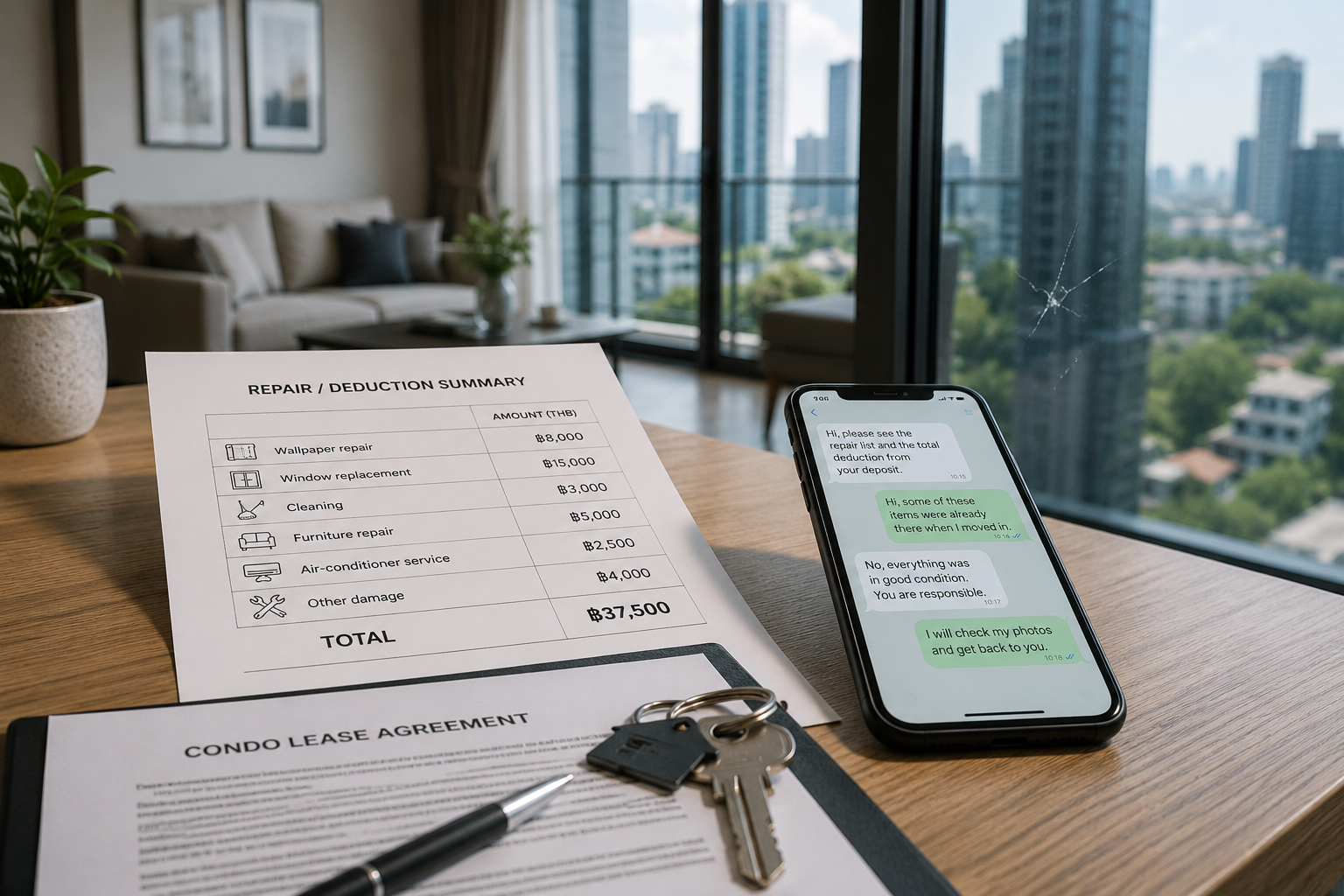
Then the agent sends you the list.
฿5,000 for wallpaper.
฿15,000 for a scratched window.
฿3,000 for cleaning.
A few thousand more for furniture, light bulbs, locks or miscellaneous repairs.
Suddenly, most of your security deposit is gone.
This is where a deposit dispute becomes difficult, because the question is no longer simply:
“Did something get damaged?”
The real questions are:
Were you responsible for it? Was it already there? Is it normal deterioration? Does your lease make you responsible? And does the amount being charged actually make sense?
Those questions depend on your own contract and evidence.
A Repair List Is Not the Same Thing as Proof You Owe the Money
When a landlord sends a deduction list, it can look authoritative.
For example:
Wallpaper repair: ฿8,000
Window replacement: ฿15,000
Cleaning: ฿3,000
Furniture repair: ฿5,000
Air-conditioner service: ฿2,500
Other damage: ฿4,000
The total is intimidating.
But the useful way to look at the dispute is not as one ฿37,500 problem.
It is as six separate claims.
For every deduction, ask:
- What exactly does the landlord say was damaged?
- What caused it?
- Was the condition documented before you moved in?
- Did you report the problem during the tenancy?
- What does the lease say about responsibility?
- Is the landlord repairing the item or replacing it?
- What evidence supports the amount being charged?
A landlord saying “you damaged the window” does not automatically answer all of those questions.
Real Bangkok Deposit Disputes Can Escalate Quickly
Recent renters in Bangkok have described exactly this pattern.
In one dispute, a tenant with a ฿48,000 deposit said the proposed deductions began around ฿25,000 and later approached ฿40,000.
The disputed items included things such as light bulbs, a sofa mark the tenant said already existed, wallpaper, a window lock and a small scratch on a glass door or window.
After challenging the deductions, inspecting the condo and collecting evidence, the renter later reported recovering ฿43,000 of the ฿48,000 deposit.
The important lesson is not that every tenant will get the same result.
It is that a large deduction list should be examined item by item rather than accepted as one final number.
Start With What Your Lease Actually Says
Before arguing about whether ฿15,000 is too much for a window, look at the contract.
Relevant clauses may cover:
- tenant-caused damage
- repairs
- maintenance
- normal use
- fixtures and furniture
- move-in condition
- move-out condition
- cleaning
- air-conditioning servicing
- security deposit deductions
The difficult part is that these clauses may interact.
Your lease might require you to return the condo in good condition while another clause allocates structural maintenance to the owner.
It may require periodic air-conditioner cleaning without making you responsible for a failed compressor.
It may allow deductions for damage without saying that every old or deteriorated item must be replaced at your expense.
This is where Kleimit can save you the manual work
Upload your rental contract to Kleimit and ask questions about the actual deduction being claimed.
For example:
- Does my lease make me responsible for this window?
- What does the contract say about furniture damage?
- Can the landlord deduct this cleaning charge?
- Which clauses matter for this wallpaper dispute?
- Does my maintenance clause cover this repair?
Instead of trying to interpret isolated sentences yourself, you can work from the terms of your actual lease.
Let Kleimit review your contract and help you examine the landlord’s deductions.
Was the Damage Already There?
This can completely change the dispute.
Imagine the landlord sends you a photograph of a mark on the sofa.
You remember seeing it when you moved in.
The landlord says they do not.
Now the important evidence may be:
- your move-in photos
- the original inventory
- an inspection report
- messages sent when you moved in
- photographs from the rental listing
- previous maintenance conversations
A five-second photo taken on move-in day can become more useful than twenty messages arguing about the sofa a year later.
This is why renters should photograph the condo carefully when they move in.
But even if you did not document everything perfectly, look through the evidence you do have before accepting the deduction.
What About Tiny Scratches and Marks?
Small cosmetic issues produce some of the most frustrating disputes.
A recent Bangkok renter reported being asked for ฿5,000 over a wallpaper scuff of roughly one or two centimeters, with the landlord saying the whole wall needed to be redone.
Another renter described a very small scratch on a glass window becoming a proposed ฿15,000 deduction.
The fact that an item is expensive to replace does not automatically tell you whether the tenant should pay the full replacement cost.
The key questions remain:
- Did you cause the damage?
- Can that actually be established?
- Does it require replacement?
- Can it reasonably be repaired?
- How old was the item?
- What does the contract say?
- What evidence exists?
Do not let the size of the quotation replace the underlying argument about responsibility.
Normal Wear, Aging and Bangkok’s Climate
Bangkok condos do not remain frozen in time.
Humidity, heat, air-conditioning, water leaks and years of ordinary use can affect:
- cabinets
- flooring
- metal fixtures
- paint
- wallpaper
- furniture
- bathroom fittings
- appliances
One Bangkok renter who had lived in the same condo for six years reported being charged for things such as rust, cabinet aging and normal deterioration.
That does not mean every rusty or worn item is automatically the landlord’s responsibility.
But it does mean age, cause and prior condition matter.
If the landlord says you damaged something, look for evidence showing:
- how long the item had been in the condo
- whether deterioration developed gradually
- whether you reported moisture or leaks
- whether maintenance was requested
- whether the condition existed before the tenancy
Messages sent months before move-out can be particularly valuable.
If you told the agent:
“Water is leaking near the floor whenever it rains.”
and the landlord later tries to charge you for swollen flooring, that message may be highly relevant to the dispute.
Thailand’s 2025 Rental Rules May Matter, but Check Whether They Apply
Thailand introduced stronger controls for residential leasing businesses in 2025.
For covered landlords operating at least three residential rental units, the rules apply to leases entered into from September 4, 2025.
Thailand’s Office of the Consumer Protection Board has stated that, for covered residential leasing businesses, deductions should relate to actual tenant-caused damage and normal deterioration from ordinary use should not be deducted from the deposit.
However, this distinction is important:
A private individual renting out one Bangkok condo is not necessarily covered by the same controlled-business rules.
Do not assume that a rule you found online automatically applies to your landlord.
Your contract, the type of landlord and the facts of the tenancy still matter.
Ask for Evidence Behind the Charge
If a landlord claims:
Window replacement: ฿15,000
you can reasonably want to understand what that amount represents.
Useful questions include:
- Is the window actually being replaced?
- Is there a quotation?
- Is there an invoice?
- Is only one component damaged?
- Was the repair completed?
- Is the charge for repair or full replacement?
This is particularly important where the landlord is claiming substantial amounts for relatively minor damage.
In one recent Bangkok deposit dispute, the renter later said that after returning to inspect the apartment, some claimed repairs or replacements had not actually been carried out as described.
That renter credited inspecting the property and gathering evidence with helping reduce the disputed deductions substantially.
Compare Every Claim With Your Evidence
This is where these disputes become time-consuming.
You might have:
- a 15-page lease
- 40 move-in photographs
- 30 move-out photographs
- six months of LINE messages
- an inspection report
- several repair quotations
- an agent giving one explanation
- a landlord giving another
The information is there.
The annoying part is connecting it.
Kleimit helps you work through that evidence in one case
You can upload your contract and supporting evidence and use Kleimit to examine what the documents show.
Instead of treating everything as one emotional argument over your deposit, work deduction by deduction:
Claim: damaged wallpaper
Contract: what responsibility does the lease place on you?
Evidence: what do your photos/messages show?
Question: does the evidence support, contradict or leave uncertainty around the landlord’s claim?
Then move to the next deduction.
That is much easier than repeatedly scrolling through LINE while trying to remember which photograph proves what.
Upload your lease and evidence to Kleimit and work through the disputed deductions for $7.
Do Not Automatically Accept “Full Replacement”
A common source of large deductions is replacing an entire item because one part is damaged.
Examples could include:
- replacing a whole wallpapered wall because of one mark
- replacing an entire piece of furniture because of one defect
- replacing a glass panel because of a scratch
- replacing equipment that was already several years old
Sometimes full replacement may genuinely be necessary.
Sometimes it may not.
The important point is that you do not have to treat “replacement cost” as the end of the discussion.
Ask what actually needs repairing and why.
Cleaning Charges Deserve the Same Scrutiny
Cleaning is another frequent Bangkok move-out deduction.
Some leases explicitly require professional cleaning or air-conditioner servicing.
Others do not.
Some tenants knowingly agree to a fixed cleaning charge.
But if you already paid a cleaning fee and then another cleaning deduction suddenly appears, ask what the second charge represents.
One long-term renter described being charged for cleaning and then seeing another cleaning-related amount appear in the repair bill.
Again, the lease and evidence determine how strong the dispute is.
Your Reply Should Challenge Specific Deductions
A weak message looks like this:
“These charges are ridiculous. I refuse to pay.”
A stronger response is structured around individual claims.
For example:
Wallpaper: disputed because...
Window: disputed because...
Cleaning: disputed because...
Furniture: disputed because...
For each one, connect:
landlord claim → contract → evidence → your position
You do not necessarily need an aggressive message.
You need a clear one.
Kleimit can help prepare that response
Once your contract and evidence are already in the case, you can ask Kleimit to help draft the response to your landlord or agent.
That saves you from manually rebuilding the entire dispute inside a message.
Kleimit can help you organize the relevant clauses and evidence before you decide what you actually want to send.
DIY vs. Kleimit
Doing it yourself
Read the entire contract.
Copy every deduction into a spreadsheet or document.
Find the clause that might apply to each item.
Search old LINE messages.
Find your move-in photographs.
Compare them with the landlord’s photographs.
Work out which claims you accept.
Work out which ones you dispute.
Draft a response explaining every item.
Check the lease again.
Rewrite the response.
Using Kleimit
Upload your rental contract.
Add the relevant evidence.
Ask questions about each deduction.
Use the AI to analyze the case context.
Organize the landlord’s claims against your documents.
Prepare your response.
Generate a PDF notice if you need something more formal.
$7. One case. One-time payment.
Before You Give Up Thousands of Baht, Check the Claims Properly
A landlord presenting you with ฿30,000 of deductions does not necessarily mean you owe ฿30,000.
Some charges may be legitimate.
Some may not.
And some may depend on details neither side has considered carefully yet.
Before accepting the final amount, work through the claims using:
your lease, your evidence and the landlord’s explanation.
If you would rather not do all of that manually, Kleimit can help organize the dispute in one place.
Kleimit is an AI assistant for rental deposit disputes. It is not a law firm and does not provide legal advice.